
7. Remediation
Contract clause
Supplier shall, if Supplier has caused or contributed to actual adverse impact, provide for remediation by
a) to the extent possible, restoring affected rights-holders to the situation they would have been in had the adverse impact not occurred and enabling remediation that is proportionate to the significance and scale of the adverse impact,
b) engaging in meaningful consultation with affected rights-holders or their representatives on appropriate remedy and
c) assessing whether affected rights-holders are satisfied with the process and outcome.
a) Restore affected rights-holders
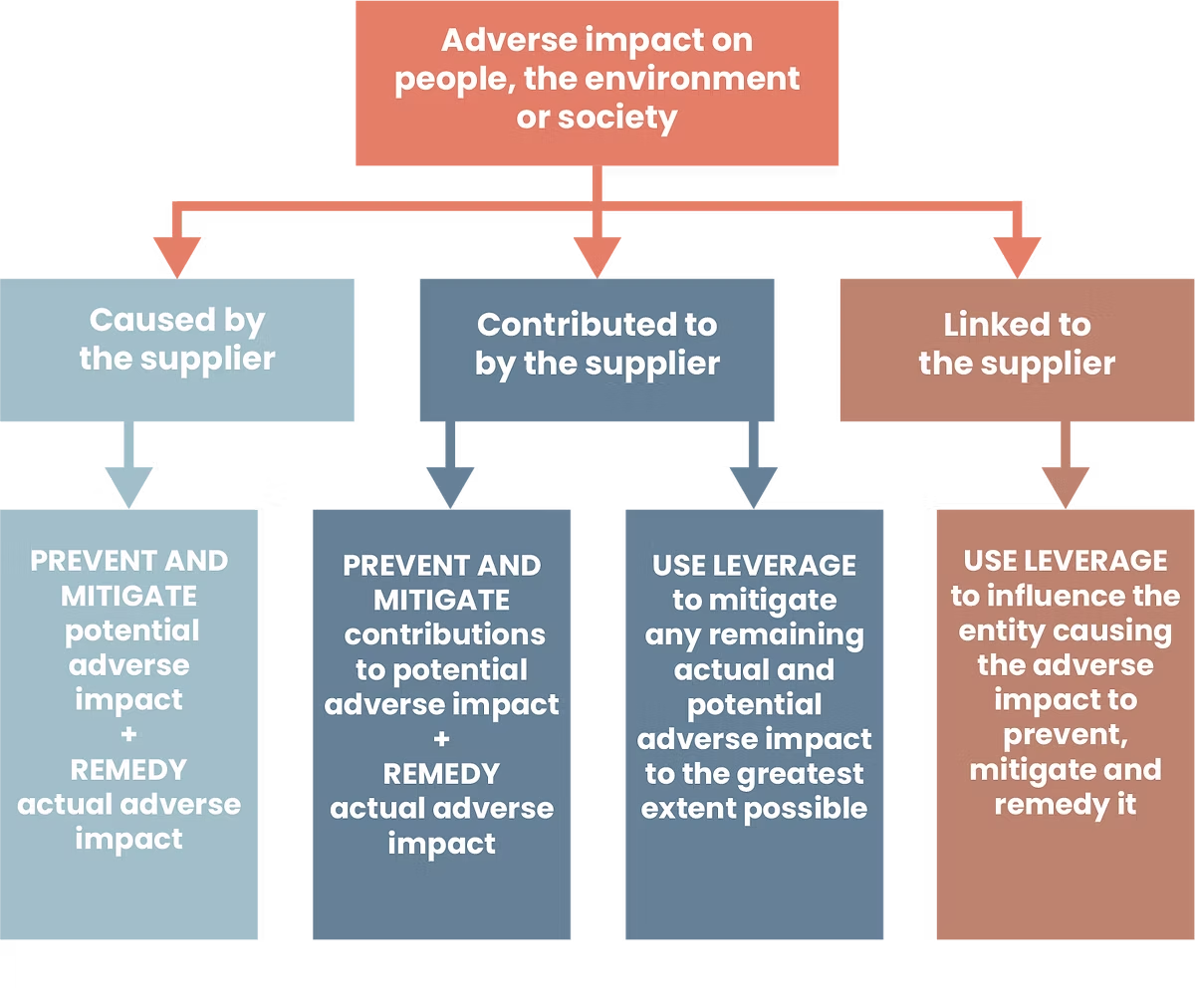
If you have caused or contributed to actual adverse impact, you shall provide for remediation by, to the extent possible, restoring affected rights-holders to the situation they would have been in had the adverse impact not occurred. The remediation shall be proportionate to the significance and scale of the adverse impact.
Remedy may, for example, consist of:
- apologies
- restitution
- rehabilitation
- financial or non-financial compensation
- judicial or administrative sanctions, such as court judgments or fines, and
- measures to prevent the adverse impact from recurring.
Some harms, such as loss of life or permanent personal injury, cannot be fully remedied. What constitutes an appropriate and proportionate remedy must therefore be assessed on a case-by-case basis.
If you have not caused or contributed to the adverse impact, but are only linked to it, you are not required to provide for remediation. However, you should use your leverage to encourage the responsible party to do so. This can often be done in collaboration with the regions or Adda Central Purchasing Body, which may also cooperate with other contracting authorities, particularly where the issues are systemic and extend beyond a single supplier.
Here is an illustration of the responsibility:
When more than one party is responsible for remediation
If you have contributed to an adverse impact but it has primarily been caused by another party, such as a sub-supplier, you should actively encourage that party to carry out remediation, participate in the process, and use your leverage to ensure that the party fulfils its responsibility.
If you contribute financially to the remedy, for example by reimbursing recruitment fees, it is sufficient that your contribution is proportionate to your contribution to the adverse impact and your leverage over the situation, including your share of the relevant purchases. The requirement to provide for remediation shall not be interpreted as imposing joint and several liability.
When the matter is being handled by a court, public authority, or NCP
If the matter is already being handled by a court or public authority, it may be appropriate to await the outcome of those proceedings, particularly where criminal conduct is suspected. Examples of such proceedings include those before courts, occupational health and safety authorities, environmental authorities, ombuds institutions, national human rights institutions, and the OECD’s National Contact Points (NCPs).
When other remedy mechanisms are used
Other established mechanisms may also be relevant, such as remediation procedures under global framework agreements, multi-stakeholder initiatives, or local community-based grievance mechanisms. If such a procedure is already underway, you should participate actively and use your leverage to help ensure an effective remedy.
We have developed a template for mapping remediation procedures, available at Templates process requirement 7. While there is no requirement to use our template, it may be a useful tool for understanding what constitutes a remediation procedure.
PAGE CONTENT
a) Restore affected rights-holders
b) Engage in meaningful consultations
Templates process requirement 7
PROCESS REQUIREMENTS DUE DILIGENCE
1. Policies and responsibilities
3. Prevent and mitigate (causation/contribution)
4. Prevent and mitigate (linkage)
RELATED LINKS SUPPLIERS
3. Supplier’s reporting obligation
RELATED LINKS BUYERS

Suggested verifications
- Instructions describing the company’s remediation process.
- Documented decisions regarding remedy, such as meeting minutes or decision records, for sample products.
- Remediation plans for sample products.
- Remediation agreements for sample products.
Guidance for auditor
Fulfils requirement
The company has instructions or equivalent documentation/templates describing how it – where it has caused or contributed to adverse impact – ensures remedy for affected rights-holders in its own operations and throughout its supply chain, including:
- How the company, to the extent possible, restores affected rights-holders to the situation they would have been in had the adverse impact not occurred.
- How the company ensures that the remedy is proportionate to the significance and scale of the adverse impact.
It is sufficient for the company to demonstrate that it has remediation procedures in place – it is not necessary to show that remediation has actually been provided. However, implemented remediation plans, meeting minutes and/or remediation agreements may strengthen the company’s claim that such procedures are in place.
Does not fulfil requirement
The company lacks instructions or equivalent documentation/templates describing how it – where it has caused or contributed to adverse impact – ensures remedy for affected rights-holders in its own operations and throughout its supply chain, or such documentation is incomplete:
- It does not specify that the company, to the extent possible, restores affected rights-holders to the position they would have been in had the adverse impact not occurred.
- It does not specify that the company shall ensure a remedy that is proportionate to the significance and scale of the adverse impact.
- Instructions or equivalent documentation exist for remediation in the company’s own operations, but not for remediation in the supply chain.
The company is unable to demonstrate how its procedures have been applied, for example through remediation plans, meeting minutes, or remediation agreements. While such documentation is not required, it may strengthen the company’s claim that appropriate procedures are in place.
b) Engage in meaningful consultations
You shall engage in meaningful consultation with affected rights-holders or their representatives on appropriate remedy. The following considerations may help determine what constitutes an appropriate remedy:
- Existing standards – In some cases, national or international standards and laws define what constitutes appropriate remediation.
- Precedents – If no specific standards exist, you can refer to previous similar cases and adapt your measures accordingly.
- Rights-holder preferences – The perspectives of affected individuals are crucial. Taking their needs and expectations into account can help ensure that the remedy is relevant and fair.
Where existing standards, precedents and rights-holder preferences are not aligned, rights-holder preferences should be prioritised.
One example of an area where precedents exist is the reimbursement of recruitment fees to migrant workers, as a measure to remediate debt bondage. Two guidance documents are provided below:
Meaningful consultations
The consultations you conduct shall be meaningful. This means that they shall be characterised by two-way communication and good faith of participants on both sides. It also means that the consultations shall be responsive and ongoing.
The four criteria are from OECD’s due diligence guidance.
| Two-way engagement means that both companies and rights-holders freely express opinions, share perspectives and listen to alternative viewpoints to reach a mutual understanding. It also means that relevant rights-holders have the opportunity to help design and carry out engagement activities themselves. |
| Both companies and rights-holders are expected to act in good faith in engagement activities. This means that companies engage with the genuine intention to understand how relevant rights-holders are affected by their activities. It also means that companies are prepared to address any adverse impacts they cause or contribute to, and that rights-holders honestly represent their interests, intentions and concerns. |
| Responsive engagement means that companies seek to inform their decisions by eliciting the views of those likely to be affected by the decision. It is important to engage potentially impacted rights-holders prior to taking any decision that may impact them. This involves the timely provision of all information needed by the potentially impacted rights-holders to be able to make an informed decision as to how the company’s decision could impact their interests. It also means there is following-through on implementation of agreed commitments, ensuring that adverse impacts to impacted and potentially impacted rights-holders are addressed including through provision of remedies when companies have caused or contributed to the impacts. |
| Ongoing engagement means that rights-holder engagement activities continue throughout the lifecycle of an operation or activity and are not a one-time endeavour. |
Suggested verifications
- Instructions describing the company’s process for engaging with affected rights-holders or their representatives in connection with the provision of remedy.
- Documentation demonstrating that such engagement have taken place, such as meeting minutes, records of discussions, or decision documents, for sample products.
- Remediation plans showing how the views of affected rights-holders have been taken into account, for sample products.
- Remediation agreements or other settlement agreements developed following engagement with affected rights-holders or their representatives, for sample products.
Guidance for auditor
Fulfils requirement
The company has instructions or equivalent documentation describing how it engages with affected rights-holders, or their representatives, on appropriate remedy, including:
- How consultations are to be conducted through two-way communication, responsiveness, good faith, and ongoing engagement.
It is sufficient for the company to demonstrate that it has procedures for engaging on appropriate remedy; evidence of actual implementation is not required. However, such documentation may strengthen the company’s claim that these procedures are in place. Examples include meeting minutes, records of discussions, or remediation agreements demonstrating that engagements have taken place.
Does not fulfil requirement
The company lacks instructions or equivalent documentation describing how it engages with affected rights-holders, or their representatives, on appropriate remedy, or such documentation is incomplete:
- It does not specify that consultations are to be conducted through two-way communication, responsiveness, good faith, and ongoing engagement.
The company is also unable to provide examples of engagements that have been carried out, which could strengthen its claim that such procedures are in place.
c) Assess satisfaction
You shall assess whether affected rights-holders are satisfied with the process and outcome.
The purpose of the evaluation is to assess whether the remedy has been effective and to capture lessons learned for future remediation processes. The evaluation also sends an important signal to affected rights-holders that their views matter, which can strengthen dialogue and help prevent future adverse impacts and escalating grievances. If the evaluation shows that affected rights-holders are not satisfied, you should consider taking further action.
Examples of methods for assessing the satisfaction of affected rights-holders include surveys and interviews. We have developed a survey template, available at Templates process requirement 7. There is no requirement to use our survey template.
Suggested verifications
- Instructions describing the assessment of rights-holders’ satisfaction with the process and outcome.
- Compilations or reports of conducted assessments, for sample products.
Guidance for auditor
Fulfils requirement
The company has instructions or equivalent documentation/templates that describe how it assesses affected rights-holders’ satisfaction with the process and the outcome.
It is sufficient for the company to demonstrate that it has procedures for assessing satisfaction with both the remediation process and its outcome – evidence of actual implementation is not required. However, such documentation may strengthen the company’s claim that these procedures are in place. Examples include completed surveys and compilations or reports of completed assessments.
Does not fulfil requirement
The company lacks instructions or equivalent documentation/templates that describe how it assesses affected rights-holders’ satisfaction with the process and the outcome.
The company is also unable to provide examples of completed assessments of affected rights-holders’ satisfaction, which could strengthen its claim that such procedures are in place.