
3. Prevent and mitigate (causation/contribution)
Contract clause
Supplier shall prevent and mitigate actual and potential adverse impacts that Supplier causes or contributes to, by
a) ceasing activities that cause or contribute to adverse impact in its own operations or supply chains,
b) establishing action plans in meaningful consultation with affected rights-holders or their representatives, with a particular focus on the most significant risks identified and
c) promoting purchasing practices that do not hinder sub-suppliers from complying with the commitments in the Supplier Code of Conduct.
a) Cease activities
You shall cease activities that cause or contribute to adverse impact in your own operations or supply chains.
“Activities” encompasses both actions and omissions, such as failing to provide safety equipment.
Causation
You cause adverse impact if your activities in themselves lead to the impact.
Contribution
You contribute to adverse impact if your activities contribute to, facilitate or encourage another party to cause the impact, or if the impact arises through a combination of your activities and those of other parties.
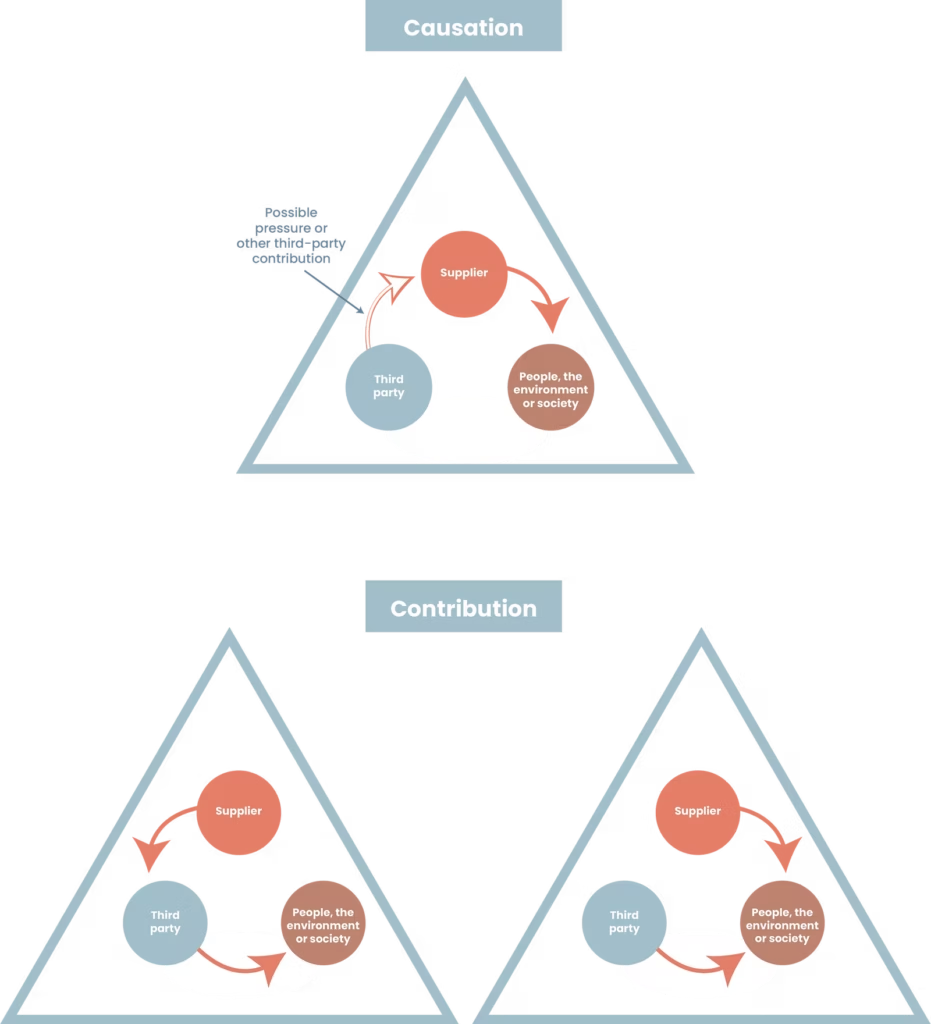
PAGE CONTENT
c) Promote responsible purchasing practices
Templates process requirement 3
PROCESS REQUIREMENTS DUE DILIGENCE
1. Policies and responsibilities
3. Prevent and mitigate (causation/contribution)
4. Prevent and mitigate (linkage)
RELATED LINKS SUPPLIERS
3. Supplier’s reporting obligation
RELATED LINKS BUYERS
Generally, you cause adverse impact through activities in your own operations, whereas contribution can arise both within your own operations and throughout supply chains.
Examples of causation
You expose factory workers to hazardous working conditions by failing to provide adequate protective equipment.
You discriminate against women or ethnic minorities in your recruitment and hiring processes.
You cause extensive contamination of the surrounding community’s drinking water through chemical discharges from production.
You pay bribes to Swedish or foreign public officials.
Examples of contribution
You emit large amounts of greenhouse gases from your operations. Although you cause your own emissions, you are not solely responsible for climate change.
You impose unreasonably short lead times or make late changes without adjusting deadlines and prices, thereby contributing to suppliers violating workers’ rights, for example through excessive overtime.
You lend vehicles to security forces that use them to travel to local villages where abuses are committed.
For a contribution to fall within the scope of the contract terms, it must be significant – minor or insignificant contributions are not covered. In the assessment, the following factors should be considered, among others:
Your impact on another party’s conduct
The extent to which your activities increase the risk of adverse impact occurring.
Your knowledge of the adverse impact
The extent to which you are aware, or reasonably should be aware, of the impact or the risk of it occurring (predictability).
Your ability to influence the situation
The extent to which you are able to prevent or mitigate the adverse impact or the risk of it occurring.
In our supply chain risk assessment template, available at Templates process requirement 3, you can document whether you risk contributing to adverse impacts in the supply chain. See also c) Promote responsible purchasing practices.
If you contribute to adverse impact, you shall, beyond ceasing activities that contribute, use your leverage to mitigate remaining adverse impact. See process requirement 4. Prevent and mitigate (linkage) for more information.
Suggested verifications
- Instructions describing how you determine whether you cause, contribute to, or are linked to adverse impacts.
- Instructions describing how you work to prevent, mitigate, and cease adverse impacts.
- Risk assessments for your own operations, in which your responsibility (causation/contribution) has been defined.
- Supply chain risk assessments for sample products, in which your responsibility (contribution/linkage) has been defined.
- Meeting minutes, board decisions, or implemented action plans showing that activities causing or contributing to adverse impacts in your own operations have ceased.
- Meeting minutes, board decisions, or implemented action plans showing that activities causing or contributing to adverse impacts in the supply chain for the sample products have ceased.
Guidance for auditor
Fulfils requirement
The company has instructions or equivalent documentation/templates that describe how it determines whether it causes, contributes to or is linked to adverse impacts in its own operations and supply chains.
Responsibility for adverse impacts has been defined in risk assessments for the company’s own operations.
Responsibility for adverse impacts has been defined in supply chain risk assessments of sample products.
The company has instructions or equivalent documentation/templates that describe how it works to prevent, mitigate and cease adverse impacts in its own operations and supply chains.
It is sufficient for the company to demonstrate that it has procedures in place to cease activities that cause or contribute to adverse impacts in its own operations and throughout its supply chains – evidence of actual implementation is not required. However, such documentation may strengthen the company’s claim that these procedures are in place. Examples include meeting minutes documenting decisions to cease activities that cause or contribute to adverse impacts in the company’s own operations or supply chain, as well as implemented action plans demonstrating that such activities have been discontinued.
Does not fulfil requirement
The company lacks instructions or equivalent documentation/templates that describe how it determines whether it causes, contributes to or is linked to adverse impacts in its own operations and supply chains.
Responsibility for adverse impacts has not been defined in risk assessments for the company’s own operations.
Responsibility for adverse impacts has not been defined in supply chain risk assessments of sample products.
The company lacks instructions or equivalent documentation/templates that describe how it works to prevent, mitigate and cease adverse impacts in its own operations and supply chains.
The company also lacks evidence of actual implementation, which could strengthen its claim that such procedures are in place.
b) Establish action plans
You shall establish action plans in meaningful consultation with affected rights-holders or their representatives, with a particular focus on the most significant risks identified.
The purpose is to prevent and mitigate future adverse impacts. Measures need to be tailored to the specific impact and designed to address the root cause of the problem.
The action plans must be documented, communicated to relevant parties, and include:
- Measures – descriptions of how you will prevent and mitigate the adverse impact.
- Timeframes – dates by which the measures must be implemented.
- Responsible persons – individuals responsible for implementing the measures.
In Sweden, legislation such as the Work Environment Act, the Discrimination Act and the Environmental Code includes requirements to take action. The legislation also requires that measures are planned and implemented as soon as possible.
Our supply chain risk assessment template, available at Templates process requirement 3, provides support for establishing action plans for adverse impacts in the supply chain.
Below are proposed measures linked to the examples above.
| Examples of causation | Proposed measures |
|---|---|
| You expose factory workers to hazardous working conditions by failing to provide adequate protective equipment. | Eliminate the hazard to prevent injuries and ill health. If this is not possible, provide protective equipment and adapt production processes where necessary. |
| You discriminate against women or ethnic minorities in your recruitment and hiring processes. | Introduce a non-discrimination policy with clear guidelines for implementation and follow-up. |
| You cause extensive contamination of the surrounding community’s drinking water through chemical discharges from production. | Install water treatment systems and adapt processes to reduce emissions and their impact. |
| You pay bribes to Swedish or foreign public officials. | Train employees in anti-corruption and establish clear procedures for reporting and handling suspected bribery. |
| Examples of contribution | Proposed measures |
|---|---|
| You emit large amounts of greenhouse gases from your operations. Although you cause your own emissions, you are not solely responsible for climate change. | Invest in more energy-efficient facilities and equipment, such as climate-smart technology or renewable energy. |
| You impose unreasonably short lead times or make late changes without adjusting deadlines and prices, thereby contributing to suppliers violating workers’ rights, for example through excessive overtime. | Adapt procurement methods through better planning, reasonable timelines, and close dialogue with suppliers. |
| You lend vehicles to security forces that use them to travel to local villages where abuses are committed. | Introduce a human rights and security forces policy with clear guidelines on how cooperation should be conducted and monitored. |
Meaningful consultation with affected rights-holders
You need to understand how people are affected by your operations. Action plans shall therefore be developed in dialogue with affected rights-holders or their representatives. If you contribute to adverse impacts in the supply chain and direct dialogue is not possible, consultation may take place through suppliers or other relevant actors.
The consultations shall be characterised by two-way communication, responsiveness, and good faith. They also need to be ongoing and followed-up to ensure that agreed measures are implemented.
Read more about meaningful consultations at process requirement 2. Risk assessments.
Particular focus on the most significant risks
Measures shall be based on the most significant risks, assessed according to likelihood and severity. This means that the most severe risks must be addressed first.
Life-threatening risks, such as inadequate safety measures, need to be addressed immediately.
Less serious deficiencies, such as a lack of guidelines against harassment, can often be addressed over a longer timeframe.
Timelines must be established based on the circumstances of each individual case. Once the most significant risks have been addressed, work should continue with the next risk in order of priority.
For guidance on how to prioritise risks based on likelihood and severity, see process requirement 2. Risk Assessments.
Suggested verifications
- Action plans for the company’s own operations, developed in consultation with rights-holders or their representatives.
- Action plans for sample products, which may have been developed in consultation with suppliers.
Guidance for auditor
Fulfils requirement
The company has documented action plans to prevent and mitigate adverse impacts that it causes or contributes to in and around its own operations – if the company is subject to legal requirements, it should at a minimum have action plans covering occupational health and safety, discrimination and/or environmental matters.
- It is clear that the action plans have been prepared in consultation with the relevant rights-holders or their representatives.
- It is clear that the consultations are characterised by two-way communication, responsiveness, good faith and continuity.
- It is clear that the action plans focus on the most significant risks (assessed based on likelihood and severity).
- The action plans contain measures, timeframes and responsible persons.
The company has documented action plans to prevent and mitigate adverse impacts that it causes or contributes to in the supply chains of sample products. These action plans should be the same as under process requirement 4, but the responsibility for adverse impacts differs depending on whether the company has contributed to the impact or is linked to it.
- It is clear that the action plans have been developed in consultation with suppliers, if relevant and the relationship is sufficiently strong.
- It is clear that the consultations are characterised by two-way communication, responsiveness, good faith and continuity.
- It is clear that the action plans focus on the most significant risks (assessed based on likelihood and severity).
- The action plans contain measures, timeframes and responsible persons.
Does not fulfil requirement
The company lacks documented action plans to prevent and mitigate adverse impacts that it causes or contributes to in and around its own operations, or they are incomplete:
- Action plans covering occupational health and safety, discrimination and/or environmental matters are missing, despite the company being subject to legal requirements.
- It is not clear that the action plans have been developed in consultation with the relevant rights-holders or their representatives.
- It is not clear that the consultations are characterised by two-way communication, responsiveness, good faith and continuity.
- It is not clear that the action plans focus on the most significant risks (assessed based on likelihood and severity).
- The action plans lack measures, timeframes and/or responsible persons.
The company lacks documented action plans to prevent and mitigate adverse impacts it causes or contributes to in the supply chains of sample products, or they are incomplete:
- It is not clear that the action plans have been developed in consultation with suppliers, if relevant and the relationship is sufficiently strong.
- It is not clear that the consultations are characterised by two-way communication, responsiveness, good faith and continuity.
- It is not clear that the action plans focus on the most significant risks (assessed based on likelihood and severity).
- The action plans lack measures, timeframes and/or responsible persons.
c) Promote responsible purchasing practices
You shall promote purchasing practices that do not hinder sub-suppliers from complying with the commitments in the Supplier Code of Conduct, meaning responsible purchasing practices.
Purchasing practices affect working conditions and other risks in the supply chain. Decisions on prices, timeframes, and contractual terms can contribute to or exacerbate adverse impacts. Below are examples of purchasing practices and the risks they may entail.
| Purchasing practice | Risk of adverse impact |
|---|---|
| Time pressure | Excessive overtime |
| Price pressure | Unfair wages |
| Late changes or short lead times | Excessive overtime, insecure employment |
| Changes to payment terms during the contract period | Unfair wages |
| Contracts without room for negotiation | Health and safety deficiencies, unfair wages, unreasonable overtime |
| Insufficient consideration of sustainability in the evaluation of tenders | All commitments |
| Lack of remedy when contributing to adverse impact | All commitments |
| Termination without responsible exit | All commitments |
A key way to promote responsible purchasing practices is to ensure that procurement functions have knowledge of how purchasing decisions affect people, the environment, and supply chains.
For practical support, there are several international guidelines and tools on responsible procurement practices, including:
Responsible Contracting Project’s shared responsibility contract clauses and buyer code
Ethical Trading Initiative’s Guide to Buying Responsibly
Working Group on Responsible Purchasing Practices
Suggested verifications
- Guidelines for responsible purchasing.
- Shared responsibility contract clauses, between buyer and supplier.
- Buyer code of conduct.
- PowerPoint presentations or screenshots from training sessions on responsible purchasing practices.
- PowerPoint presentations or screenshots from training sessions on responsible purchasing practices.
Guidance for auditor
Fulfils requirement
The company has instructions or equivalent documentation/templates describing how it promotes responsible purchasing practices. This may include:
- Responsible purchasing guidelines, contract clauses on shared responsibility between buyers and suppliers, or a buyer code of conduct.
- Evidence that the procurement team has received training on responsible purchasing practices, such as PowerPoint presentations or screenshots.
- Meeting minutes or similar documentation demonstrating that the company has made decisions to improve purchasing practices (e.g. longer lead times, adapted pricing models, or revised payment terms).
Note that the documentation does not need to be linked to the sample products.
Does not fulfil requirement
The company lacks instructions or equivalent documentation/templates describing how it promotes responsible purchasing practices.
- There are no responsible purchasing guidelines, contract clauses on shared responsibility between buyers and suppliers, or a buyer code of conduct.
- There is no evidence that the procurement team has received training on responsible purchasing practices, such as PowerPoint presentations or screenshots.
- There are no meeting minutes or similar documentation demonstrating that the company has made decisions to improve purchasing practices (e.g. longer lead times, adapted pricing models, or revised payment terms).
Nor is there any other evidence that the company promotes responsible purchasing practices.