
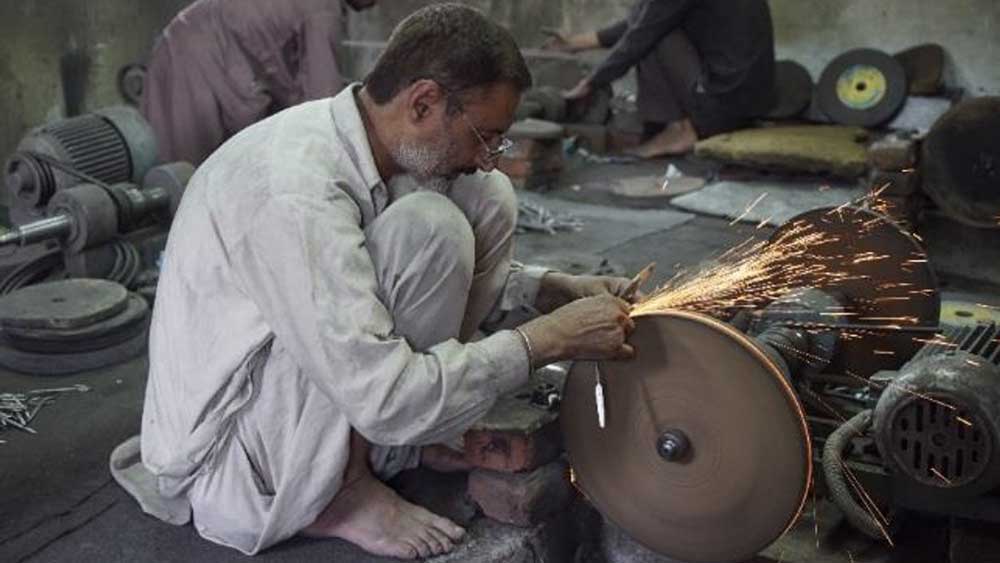
“Children in Pakistan manufacture surgical instruments for Swedish healthcare.”
The revelation made in 2007 led to criticism of Sweden’s regions for using taxpayers’ money to fund operations that violated human rights.
The revelation became the starting point for a new collaboration between Sweden’s regions to promote sustainability in healthcare procurement. And eight years later, significant improvements could be observed at factories in Pakistan.
But risks of child labour and violations of workers’ rights remain imminent in the country, and the regions continue working towards improvements.
It was the independent watchdog organisation SwedWatch that in 2007 revealed severe misconduct at factories in Pakistan manufacturing basic surgical instruments for Swedish healthcare. The report “White coats and sharp scissors – a report on county councils’ lack of ethical purchasing” had a major impact, with images of child labourers widely circulated in the media.
The background to the report was the inspections SwedWatch conducted on site to shed light on working conditions in the production of products used in Swedish hospitals.
A large share of the instruments purchased – such as scissors, tweezers, and clamps – were delivered via Swedish importers who bought them from manufacturers in the industrial city of Sialkot in Punjab province in northeastern Pakistan.
Human rights were violated
The inspections revealed that human rights were being violated at the factories. Workers reported low wages, long working hours, and exhaustion, while at the same time expressing a strong fear of losing their jobs. The report and the subsequent criticism led the three largest regions to initiate a collaboration to address risks in their supply chains in an effective and coordinated way.
Clear requirements were now placed on suppliers based on the code of conduct adopted by the regions in 2010, covering human rights, workers’ rights, environment, and business ethics.
The regions initiated several follow-ups, as well as increased industry dialogue and development work, in order to address the risks.
In October 2014, SwedWatch returned to Pakistan to investigate whether improvements in working conditions and labour rights had taken place as a result of the new requirements in procurement contracts. In the report Healthier procurement, it was described how the introduction of social criteria in the regions’ and county councils’ procurement had in fact produced tangible results at the factories in Pakistan: child labour was actively countered, statutory minimum wages were introduced, overtime was regulated, and the physical environment improved. Conditions among subcontractors to the export factories also improved.
The regions’ work delivered results
The initiatives carried out within the framework of the regions’ collaboration achieved a partial victory.
The development at the factories in Pakistan was clear proof that structured methods integrating social criteria into the procurement process could lead to improved working conditions in production countries.
But even though improvements could be observed in the exporting factories, challenges remained in instrument manufacturing. Above all, shortcomings in health and safety were noted, as workers still operated machinery without protective equipment. Wage levels, although in line with the law, were still considered insufficient, and there were no opportunities for collective bargaining.
SwedWatch also emphasised that improvements had only taken place in factories included in supply chains where requirements had been set and follow-ups conducted. Major challenges remained among subcontractors, often small manufacturers and workshops around Sialkot. It was in these links that the risk of child labour remained high.
In autumn 2017, a partner organisation, Norway’s Sykehusinnkjöp, which is responsible for procuring medical supplies for all Norwegian regions, made a discovery showing how complex the situation was to manage. During a visit to surgical instrument manufacturers in Tuttlingen, Germany, it was found that parts of the production process had been outsourced to subcontractors in Pakistan.
Complex global supply chains
From German steel, components were produced in Sialkot, then final assembly was carried out in Germany. In practice, this means that even instruments labelled “Made in Germany” often have origins in Pakistan. The risks therefore affect not only companies buying directly from Pakistan but the entire industry on a global level.
Region area A in the regions’ collaboration (Västernorrland, Västerbotten, Norrbotten, and Jämtland-Härjedalen), with national responsibility for the procurement category of instruments, developed a new risk analysis for the area. It indicated that risks, in addition to manufacturing in Pakistan, are generally greatest in the raw material stage. Public information sources show that there are major environmental and human rights risks linked to iron ore extraction and scrap metal recycling for stainless steel production. The analysis also showed that knowledge of the complex and poorly transparent supply chain and its risks beyond the manufacturing stage is limited.
An article in the British newspaper The Guardian highlighted in 2018 the risk that surgical instruments used in the UK healthcare system had been produced by children (and Svenska Dagbladet later reported on the same issue in Sweden).
The Guardian reported illegal child labour in at least a dozen small workshops in Sialkot, where children as young as twelve were making surgical instruments under hazardous conditions. The report noted that the risk of child labour increases when adult workers’ wages are insufficient to support their families.
The office visits Pakistan
The information from Sykehusinnkjöp’s visit to Germany, combined with the new findings from The Guardian, led the regions to take an unusual decision: to investigate production on site in Pakistan. In spring 2018, the regions’ office for sustainable procurement and Sykehusinnkjöp carried out a joint study visit in Sialkot.
They visited five export factories, several subcontractors, an industry association, and a child rights organisation. The purpose of the trip was to understand the general challenges facing the industry as a whole: manufacturing practices, working environment and conditions, and the requirements and expectations placed on manufacturers in Pakistan regarding production risks.
The lessons learned from the visit to Sialkot, published in the report Instrument manufacturing in Pakistan, were several. The most important was that despite improvements, significant challenges remained in instrument manufacturing, but the solution is not to stop buying instruments from Pakistan. Rather, it is essential to ensure that instruments are purchased from suppliers with processes and routines in place to identify and manage risks in their supply chains.
The project provided valuable insights and a clear understanding that the risks of child labour remained high, especially among subcontractors. Based on this insight, the regions developed guidance to be used when and if child labour is discovered. The guidance, Risk of child labour in the surgical instrument manufacturing industry in Pakistan – recommendations for an action plan, was formulated by the office together with staff from the four northernmost regions responsible for surgical instruments within the collaboration.
Ongoing fight for sustainability
Sweden’s regions have continued dialogue with stakeholders such as the industry association Swedish Medtech in Sweden and various NGOs to advance efforts to reduce risks in instrument manufacturing in Pakistan.
Taken together, the story shows that methods involving clear requirements, regular follow-ups, and collaboration can make a difference. But hard work and patience are needed to ensure that surgical instruments for healthcare are produced under responsible conditions. The regions continue working to reduce risks, increase transparency, and – above all – ensure better working conditions for factory workers. Each step in the right direction offers hope for a future where everyone, regardless of country, can work under safe and fair conditions.
Facts: instrument manufacturing in Pakistan
Every day, thousands of surgical instruments are used in Swedish hospitals. A significant share of these instruments come from the industrial city of Sialkot in Punjab province in eastern Pakistan. The area produces over 150 million instruments per year, with an export value of USD 358 million.
(Source: http://www.simap.org.pk/)
Surgical instruments can range from simple tools such as scissors, clamps, and tweezers to more advanced surgical instruments.
Simple instruments are manufactured in stainless steel and can be purchased for either single-use or reuse. In Sweden, both single-use and reusable instruments are procured, while neighbouring Norway primarily buys reusable instruments.
The instruments are purchased by Swedish or international wholesalers, who usually source them from the medical technology cluster in Tuttlingen, Germany, or directly from Sialkot in Pakistan. Reports have indicated that instruments purchased from Germany may be wholly or partly manufactured in Pakistan.
Instrument manufacturing in Sialkot began in the late 1800s when doctors from the American Mission Hospital in Sialkot brought their instruments to local blacksmiths for repair. Sialkot was already known for metalwork, primarily the production of knives and swords. The workers in Sialkot quickly managed to replicate the instruments and soon began producing their own for export.
Over 99% of surgical instrument production in Pakistan takes place in Sialkot. The sector consists of over 2,500 companies, including around 30 large firms, 150 medium-sized firms, and the rest small businesses. These operations usually employ between 15 and 450 workers each (excluding hired labour). 95% of total production in Pakistan is exported, of which around 60% are single-use instruments and 40% reusable instruments.
The steel used in the instruments is most often Japanese, German, or Pakistani. Steel production in Pakistan takes place, among other places, in the Daska area near Sialkot. This steel is mainly produced from scrap and recycled material.
The production chain can take many forms. Forging may, for example, take place at a German company that then sends semi-finished products to Pakistan for further processing. The instruments are then returned to Germany for final assembly and sale to the end customer.
In some cases, the entire process may also take place with subcontractors. Factories may work with up to 500 subcontractors, and the supply chain – both globally and locally – can therefore be difficult to map.